By Gerard Silva, Director of Exhibitions and Community Outreach at Fleisher Art Memorial
The immigrant experience and Fleisher Art Memorial have a long history. Samuel Stewart Fleisher, the son of German Jewish immigrants, developed an interest in enhancing the lives of workers in his family business through the arts. The Fleisher Yarn Company in Philadelphia was one of the nation’s first and most successful worsted woolens mills in the United States. When Samuel Fleisher joined the company, most of the neighborhood around the Jewish Union Building at 4th & Bainbridge, our organization’s first home, was inhabited by newly arrived immigrants of Russian, Italian, and Irish descent. Mr. Fleisher had a real interest in the arts and felt that providing free art lessons could enhance and enrich one’s life. It could be deduced that Mr. Fleisher’s intention was to create a home away from home in which art provided an escape from daily routine and the unforeseeable and challenging reality of living in a new city.
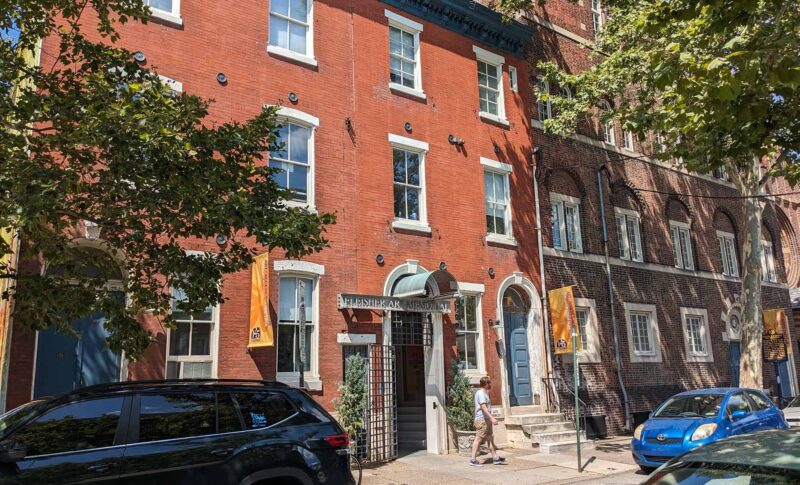
In creating this community art center in the late 19th century, Mr. Fleisher was ahead of the curve. He created a safe space for all in which art played a transcendent role in the lives of residents and immigrants alike. Mr. Fleisher was forced to expand and move locations due to the popularity of the classes. Our current location at 719 Catharine Street is a series of buildings linked together that includes what was once a church and is now known as the Sanctuary, a space where creativity comes together. In many ways, the Sanctuary is a particularly great metaphor for Mr. Fleisher’s intentions: Art is spiritual because it lives within us and in order for art to manifest itself in our lives, we must create, we must share, and we must experience it. Making art accessible to all also means coming together and opening our doors to the many diverse communities in Philadelphia. Our Sanctuary space has proven to be that sacred shared space for creativity.
As immigration continues to shift in our area, working with communities that are making new homes in Philadelphia continues to be a priority for Fleisher Art Memorial and in order to serve them better and make strong connections, empathy is necessary. Art can and does serve as a tool for better understanding non-Western cultures and traditions and thanks to the Pew Center for Arts & Heritage, 360 Culture Lab was created to collaborate with two local organizations: Modero & Company and Casa de Venezuela. Through this collaboration, each organization worked alongside Fleisher as a partner in order to organize cultural events showcasing the creativity of their homelands. In promoting their respective traditions and allowing them to engage and represent their communities, 360 Culture Lab enriched and expanded the cultural spectrum of Philadelphia as a whole, not just on Fleisher’s campus. The pandemic gave us the opportunity to explore new, creative ways to engage the public, and outdoor spaces became as necessary as our indoor spaces. Sustainability meant that we worked together to strengthen our mission while continuing the work of inclusion by making Fleisher a space in which you feel at home and to which these communities return again and again.
The multiple ideas of “home” experienced by Fleisher’s community turned out to be the thread that knitted the experiences of these various community stakeholders together. In many people’s minds, a home has walls, floors and ceilings, doors and windows. It is an enclosed structure, the place we define with an address, a residence. But “home” is also a state of mind, a place that gives us comfort, a place that we yearn for and is full of memories. This notion varies immensely depending on age and life circumstances such as immigration and family systems. Most of us, as kids, know home as a place we return to from school and the place we consume food and watch TV. This home provides us with basic needs and if we are fortunate enough, with a set of parental figures. As we grow older and responsibilities shift in our lives, home becomes a place in our minds and our hearts.
This concept of home evokes a deeply personal narrative with many variants and subdivisions. The narrative for the immigrant community is more complex as they navigate two constructs of home: the one left behind and the new one in which they landed. Home is where family still lives, home is where most childhood memories live, home is the food you eat, home is the streets you know. The new home often presents many challenges – sometimes language, sometimes documentation, and most definitely a lot of uncertainty. Yet making yourself at home in a new space means feeling comfortable and at ease in order for you to enjoy yourself. This concept was the foundation of what we know now as Fleisher Art Memorial: a connection between immigrant communities and art that continues to flourish and expand in the organization today.
Being an immigrant implies that you left your homeland for another. That definition makes it sound permanent, which in many cases it is, but this is not necessarily true every time. The reasons for immigration are in constant flux, often triggered by uncertainty or unjust conditions around the world. From political turmoil to warfare, from human rights violations to socioeconomic inequalities, the reasons for immigration are constantly changing. While there are some exceptions and migration can be voluntary, due to marriage or employment for example, it is fair to say that there’s still an adjustment period in which some type of safety net, such as a community, is necessary for an immigrant’s well-being.
Immigrant communities are the result of an influx of individuals and families from a particular country that often decide to reside in a particular area or neighborhood of the adopted homeland in order to provide each other with a safety net, a home away from home. Residing in the same area offers the community a support system that is hard to duplicate. Being surrounded by familiar faces, food, language, and customs in a new environment is the most welcoming experience for an immigrant. Whether the new location is a temporary shelter or a permanent home, connections are made that will help navigate the set of challenges ahead from basic needs to the complex immigration process. Feeling connected with a support system is a wonderful thing!
It is important to also acknowledge the traumas of displacement. The act of forced immigration often creates a humanitarian crisis for immigrants and defines them as refugees in another land, affecting both the immigrants and the local residents in the area. Since neither side is often completely prepared for this challenge, misunderstandings, conflict, and human rights violations can emerge. From my own personal experience, I’ve observed the challenges of displacement within family members of immigrants, especially with youth and the elderly, who are often not part of the decision making or planning of a relocation and are more vulnerable to mental stress in the adjustment process. There are many programs and organizations in cities designed for assistance in such cases. From Fleisher’s perspective, we observed that participation in any form of a creative outlet has beneficial outcomes and helps with the overall mental health of its participants. Programs such as Fleisher’s Teen Lounge (free for teens 13-19) or Creative Aging (free for Latinx individuals over 55) can have a positive effect on displaced members of a community. Providing a safe space and environment for creativity encourages inclusion and benefits everyone involved.
The feeling of displacement is something we all experience at some point in our lives, but it is more prevalent when all your surroundings are unfamiliar, so it is felt acutely among immigrant communities. For this reason, it is crucial for cities to have cultural and art spaces in which communities can come together to showcase and celebrate their culture and traditions. Art and culture are forever interwoven and as we continue equalizing the importance of Western and non-Western art, we become more inclusive and enjoy the benefits of acceptance. There is still a great need to keep growing, learning and expanding our art vocabulary as the world continues to evolve and broaden the definition. After 125 years, Fleisher is still committed to these principles and the need to evolve and the generosity of the Pew Center for Arts and Heritage continues to allow us to explore this work.